Updated and refreshed on 10 January 2026.
Simon Thackray submission to the Planning Inspector Mr David M H Rose and interested parties.
Appeal Reference: APP/U2750/W/25/3371863
Planning Application ZE24/01683/MOUT re Land off Rainbow Lane, Malton, North Yorkshire for 200 houses.
Copy of the submission sent to Beth Evans of Freeths on 9 January 2026
The Malton and Norton Pumping Plan is operated by Yorkshire Water in collaboration with North Yorkshire Council and the Environment Agency, with occasional support from North Yorkshire Fire & Rescue and North Yorkshire Police, in response to repeated flooding events linked to raised water levels in the River Derwent that prevent the North Yorkshire highway drains and Yorkshire Water combined sewer overflows (CSOs containing surface water and sewage), from effectually draining the area.
A lack of hydraulic capacity in the Malton, Norton and Old Malton sewerage system (there is only one system), including lack of pumping station capacity (coupled with badly designed flood defence walls constructed by the Environment Agency in 2003) means the ‘partnership’ has resorted to pumping combined sewage directly over the flood walls into the river. Welcome to the North Yorkshire version of Hogarth’s London. We live next to an open sewer, where even the contents of the Norton public conveniences are pumped directly into the River Derwent SSSI, SAC. It’s free to pee and pollute the river!
New sketch of Norton public conveniences here. Note piped discharge directly into the river:
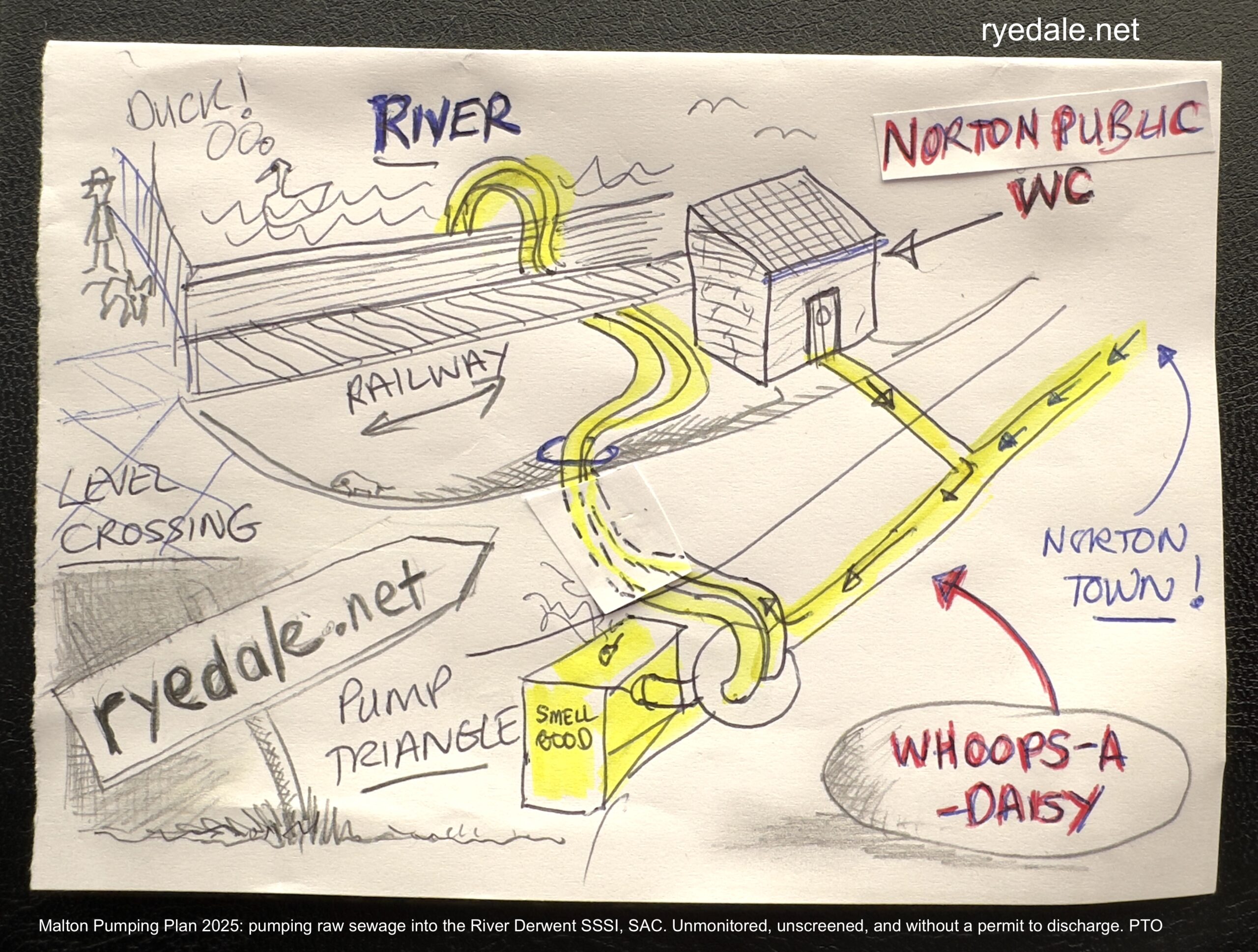
Although described as a temporary, emergency, pumping plan, this polluting plan has been used repeatedly since 2012. The plan depends entirely on pumping the contents of combined sewers (raw sewage) directly into the River Derwent, a designated SSSI and SAC. This is no longer an emergency response – it is planned-for, and deliberate, pollution of a sensitive watercourse.
The river Derwent is a repository for thousands of tonnes of raw sewage each year c/o Yorkshire Water, with kind permission of the Environment Agency and North Yorkshire Council. The river Derwent is the mediaeval open sewer of the self-proclaimed Food Capital of Yorkshire.
Pumping Plan – Operating Costs (Nov 2023 – Feb/Mar 2024)
North Yorkshire Council flood alleviation: £130,750
Environment Agency operations: £363,000
Concrete block removal: £3,000
New plastic bollards: £12,000
Total: £508,750

Background to the Pumping Plan:
The plan was originally conceived and operated as an emergency measure. Proposed permanent engineering works estimated at £4 million (in 2018) have not been carried out. There has been no increase in the Yorkshire Water Malton sewage treatment capacity in the past fifteen years despite a 40% growth in population.
Yorkshire Water combined sewer overflows discharge sewage into the River Derwent during high-river level events. It is permitted to discharge sewage into the river in exceptional circumstances only, but in practice raw sewage is being discharged into the river during unexceptional weather events i.e. during even mild to heavy rain showers. This fact is confirmed by EDM data (sewage spill ‘Event Duration Monitoring’ data) which shows the number and duration of sewage spills each year.
The ‘combined’ sewerage system means the floodwater contains sewage, creating health risks and causing disruption, particularly on Castlegate where the road becomes flooded and blocks vehicular access between Malton and Norton, causing tens of thousands of pounds of losses to local businesses.
Arup report October 2015 – Key Findings (Executive Summary)
Sewer flooding from overloaded combined sewers is highly unpleasant for residents and businesses. Reliance on emergency pumping is not a viable long-term solution if investment could reduce long-term costs. Temporary pumping has limitations: pump availability is not guaranteed; the system lacks dedicated deployment points; and local disruption continues.
Sewage Discharge
The pumping plan involves the deployment of up to 20+ portable pumps (plus tankers) to discharge (pump) sewer contents into the River Derwent SSSI, SAC. This additional pollution is not monitored or regulated. A permanent Yorkshire Water pipe at Church Street, Norton discharges untreated sewage into the river (separate from the permitted CSO), with sewage debris visible on the riverbank. See below.

The multi-agency partnership of North Yorkshire Council, Environment Agency and Yorkshire Water is knowingly and deliberately (and without a licence to discharge) polluting the River Derwent SSSI, SAC by operating the ‘temporary’ pumping plan.
Yorkshire Water pumps raw sewage (untreated sewage) into the river Derwent SSSI from its combined sewer on Church Street, Norton via permanent pipes under the highway and railway line. NB: For clarity, this is NOT the Norton Church Street CSO. Anyone interested should walk to the Norton side of County Bridge (on the eastern footpath) and see for themselves the sewage detritus (used sanitary towels, toilet paper etc) hanging from the bushes on the riverbank next to the unlicenced and unmonitored outlets.
None of the extra sewage pollution caused by the multi-agency pumping plan is monitored or regulated. If you think the Yorkshire Water sewage spill data is bad, add to that the tonnes of sewage pumped into the river by the Multi-Agency Pumping Plan.

Yorkshire Water sewage ‘spill’ data for 2019, 2020, 2021, 2022, 2023, 2024
Environment Agency EDM Records (Links to individual years)
NEW: Yorkshire Water live storm overflow map
Simon Thackray submission to the Planning Inspector Mr David M H Rose
7 January 2026
Appeal Reference: APP/U2750/W/25/3371863
Planning Application ZE24/01683/MOUT re Land off Rainbow Lane, Malton, North Yorkshire for 200 houses.